A man gets blocked. Most people would mute the account, delete the photos and go for a long walk. In “Moor Money,” he buys the street. Then the bar on the corner. Then, for good measure, her yoga studio. The woman telling the story watches all this with the weary patience of someone who has seen it before, and the joke lands because we have all known a version of him. It just took Emily Brontë to give him a moor and a fortune.
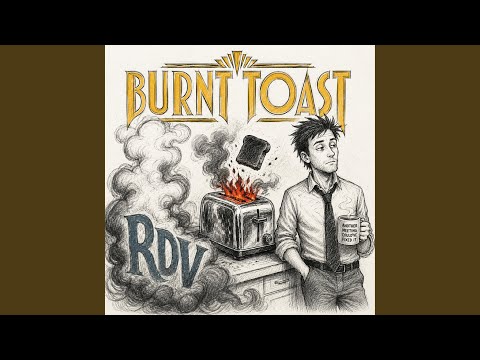
That is the trick at the heart of Burnt Toast, the album Rue de Vivre released on June 14, 2026. Fourteen songs, each drawn from a classic novel or play, each told from inside the story in the language people actually use now. Heathcliff becomes a man with a property habit and no closure. Elizabeth Bennet is too proud to text first. Hamlet cannot. The canon, it turns out, was full of people who would have been very bad at group chats.
Rue de Vivre is the musical identity of RDV, an LA writer, songwriter and composer. On this record the reading comes first. The music follows it into the room.
A title that admits something
Burnt toast is what happens when you try to do three things at once. It is still breakfast. You eat it anyway, scraping off the worst of it, because the day has already started.
That small domestic failure is a useful way to read the album. Most of us meet the classics in a slightly overdone state: assigned, summarised, half-remembered from school, printed on tote bags. Burnt Toast does not pretend otherwise. It takes these stories as they actually reach a modern reader and asks what still tastes right. The answer, again and again, is the people.
Fourteen books, fourteen voices
The songs are not plot summaries. Each one picks a character, usually the one with the most to lose, and lets them speak.
Pride, pursuit and the problem of texting first. “First Move,” built from Pride and Prejudice, sits with Elizabeth Bennet in the moment she realises she might have read someone wrong. She will not shrink to fit anyone's expectations, and she will not send the first message either. The song is a defiant love letter written in invisible ink, and it ends somewhere between pride and surrender, which is exactly where Austen leaves her for most of the novel. “Green Light Gaslight” turns to The Great Gatsby and looks hard at Daisy Buchanan, a woman everyone talks about and almost nobody listens to.
Obsession dressed as devotion. “Moor Money” is the album's funniest song and, by the end, one of its saddest. The verses play Heathcliff's grief for laughs: the blocked accounts, the unblocking every few months, the purchases that read like messages. Then the beat falls away into a long, quiet comedown and the narrator stops joking. You can buy a skyline, the song decides. You cannot buy back the morning.
Performance and the self. “Main Character (I Cannot)” hands Hamlet a very modern condition: knowing exactly what you should do and being unable to start. “No Filter (The Portrait)” takes The Picture of Dorian Gray to its obvious contemporary home, a world of edited faces and a hidden version of yourself that keeps the receipts. It is the album's glossiest track, dressed in glitter-disco and big-room house, because Dorian would have wanted it that way.
Women taking the pen back. A run of songs gives the story back to the women who were written about rather than listened to. “Equal (Reader, I)” takes Jane Eyre's famous insistence on her own worth and sets it to a steady afro house groove. “Little Woman, Big Manuscript” follows Jo March and her ambition, and lets the comedown hit hard. “The Calibration” is Lady Macbeth in uplifting gospel house, a study in control. “The Fault Line” sits with Blanche DuBois from A Streetcar Named Desire, where the music drifts from gospel lift into something more fragile. And “The Trap Was the Language” tells the story of Lolita from Dolores's side, about how a voice can be used to cage someone. It is the most serious song on the record, and it refuses to romanticise anything.
Outsiders and confessions. “Unbound,” from Frankenstein, gives the creature a gospel house anthem about throwing yourself the party you were never invited to. “The Gold Ring” brings Holden Caulfield's eye for phonies to a slow afro house closer. “Say It Plain,” drawn from Crime and Punishment, turns Raskolnikov's long road to confession into a sunset deep house track, and “All the Way Down” sets the systemic pressure that crushes Anna Karenina to a rolling afro house pulse.
The canon was full of people who would have been very bad at group chats.
The sound of the record
Burnt Toast is a dance record that takes its time to break your heart. A few choices hold it together.
The kalimba. A thumb piano runs through the album as a recurring voice, a small, bright, slightly lonely sound that appears in different songs like a character passing through different chapters.
The low end. Deep sub-bass is the spine of almost every track, with log drums and hand percussion from afro house carrying the rhythm. It is music you feel before you analyse.
The choir. Call and response, borrowed from gospel and soul, gives many songs a communal voice. When the lead vocal states something, the chorus answers, agrees, argues or comforts.
The comedown. Several songs start at a steady 120 BPM and slowly sink toward 110 as the beat strips away, leaving a drone, a few echoes and the honest version of whatever the character was joking about earlier. It is a dance-floor structure with a novelist's instinct: the last page is quieter than the first.
The hook comes first. Most songs open straight into the idea, with no long intro, and most finish in under four minutes. The lyrics are clean and written in plain modern English. No thee, no thou, no costume.
Genre-wise, the album moves through deep house, UK garage, afro house, future house and gospel house, with one glamorous detour into disco. The common thread is warmth. Even the darkest stories here are told with a pulse.
Two endings for the same character
One of the album's quieter ideas is the pair. Some characters appear in two versions built on different readings of who they are: one in gospel house, one in afro house; one triumphant, one devastated. It is a way of playing an argument as audio. Is Jane Eyre's story a victory or a survival? The music lets you hear both, and decide.
Why the classics keep coming back
Wuthering Heights was published in 1847. Pride and Prejudice appeared in 1813. Hamlet is older than both by a couple of centuries. Each generation still finds a way in, from film adaptations to annotated editions to the online reading communities that trade candlelit study photos under the banner of “dark academia.”
Part of the appeal is that these books are about feelings that do not date. Pride, jealousy, ambition, grief, the agony of waiting for someone to reply. Strip away the bonnets and the moors and you find people making the same mistakes we make now, only in longer sentences. Burnt Toast leans into that recognition. It does not modernise the classics by changing what happens. It changes who gets to tell it, and how it sounds.
Music for reading, and for what comes after
Parts of the record are made to sit beside a book. “Connecting on the Sea” is the clearest example, an electronic piece for reading that asks very little of your attention and gives back a sense of momentum. For a whole sitting, “Dusk,” an hour-long Burnt Toast album mix on YouTube, runs the record as a continuous set. Many readers find that music with low or no vocals and a steady pulse keeps them company without competing with the words on the page.
How to listen to Burnt Toast
With the book. Pick one of the fourteen sources, read a chapter, then play its song. The contrast between the original voice and the modern one is half the fun.
Start to finish. Play the album in order and listen for the kalimba moving from song to song, and for the comedowns that close so many tracks.
On the move. “First Move” and “Moor Money” have enough pulse for a walk home. Let the characters come with you.
Continuity, not reinvention
Earlier Rue de Vivre records moved between dancehall on Okina Sakana, the nightlife stories of Rooftop Confessions and the digital-age love songs of Group Chat. What connects them is a point of view: an interest in how people manage ambition, connection and the small absurdities of being alive. Burnt Toast turns that curiosity on the oldest stories on the shelf and finds them surprisingly current.
Somewhere in the middle of “Moor Money,” after the jokes run out, the narrator says the plain thing: he won every little war and still lost the one that mattered. It is a line Brontë would recognise. It is also a line you could send to a friend tonight.
Questions people ask
When was Burnt Toast released? Burnt Toast by Rue de Vivre was released on June 14, 2026. The full album is available as a playlist on YouTube and YouTube Music.
What is Burnt Toast about? Each of its fourteen songs retells a classic novel or play from a character's point of view in modern language, including Pride and Prejudice, Wuthering Heights, Hamlet, The Great Gatsby, Jane Eyre, Frankenstein and Little Women.
What genre is Burnt Toast? Deep house, afro house, UK garage, future house and gospel house, built around deep sub-bass, log drums, a recurring kalimba and call-and-response vocals.